A Call for Choice in Real Estate Exchange Strategies
Investors deserve the ability to evaluate both 1031 and 721 exchange tax-deferred solutions based on their individual investment goals.
October 28, 2026

Executive Summary
The real estate tax exchange marketplace is evolving quickly, with 721 exchange strategies1 playing an increasingly prominent role in discussions around tax-advantaged real estate investing. Current Mountain Dell Consulting data reflects the continued prominence of Delaware statutory trust (DST) programs featuring a potential future 721 exchange component, with such programs representing approximately 52 percent of total DST sales as of late September 2026.2 For many, the ability to participate in a future 721 exchange is a valuable consideration for a potential investor in a DST program, offering tax deferral, passive ownership, and potential diversification. A DST that provides investors with the potential future ability to participate in a 721 exchange, sometimes referred to herein as a 721 DST, may also appear attractive because of its potential future liquidity features, however, accessing this liquidity may be limited. Despite the growing attention around 721 exchanges, a traditional 1031 DST3 offers many advantages that may be overlooked or not presented to prospective investors by wealth management firms that only offer a single exchange structure. A one-size-fits-all approach to real estate exchanges may not be the best solution for your clients.
In today’s marketplace, the way exchange solutions are proposed to investors has become increasingly important. In cases where investors are introduced to real estate exchange opportunities through wealth management firms that offer a single exchange structure, conversations can become centered on that one solution rather than a comprehensive evaluation of the full range of available exchange strategies in search of what is best for the investor. The choice between a traditional 1031 DST and a DST with a potential future 721 exchange component should begin with investor objectives because each can support tax deferral, but a range of other considerations must also be evaluated.
For nearly six decades, Inland has been guided by a steadfast belief: investment solutions should be shaped by investor objectives. While there are currently 53 active sponsors in the exchange marketplace, not all provide access to both traditional 1031 DST and 721 exchange strategies.2 Inland’s ability to offer both traditional 1031 DST and 721 DST strategies helps preserve investor choice and supports a more balanced evaluation of available tax-deferral options.
This distinction is critical. Investors and financial professionals deserve the ability to evaluate the full range of tax-deferral exchange options available. A DST with a potential future 721 exchange offers many unique benefits and is a valuable addition to the toolkit of financial professionals and clients looking to manage investors’ real estate tax obligations. Because of these benefits, Inland will continue to be an active participant in the field of 721 DSTs, while maintaining its prominence with traditional 1031 DSTs. This article is not intended to diminish the value of 721 exchange strategies; rather, it is a reminder that traditional 1031 DSTs remain an important part of a balanced, investor-centered exchange conversation.
The Current Exchange Landscape
Over the past several years, the 721 DST has gained greater visibility, as sponsors and platforms have introduced a new potential pathway from fractional real estate ownership into ownership of a larger portfolio of assets owned by a real estate investment trust, or REIT. For investors who no longer want to manage real estate directly, this can appear attractive, offering professional management, portfolio diversification, and the possibility of limited liquidity over time.
In many cases, however, investors are exclusively presented with 721 DSTs as the natural or preferred next step, while traditional 1031 DSTs are discussed less frequently. This framing can understate the value of a traditional 1031 DST. In reality, a traditional 1031 DST may serve as a meaningful long-term planning tool for investors seeking continued tax-deferral, asset-level visibility, and future exchange flexibility. The traditional 1031 DST has unique advantages relative to a 721 DST and addresses some of the concerns that exist when employing a 721 exchange as part of a tax-deferral strategy.
Investors considering a tax deferred exchange often have highly individualized needs and therefore must have the choice between both 721 DST and traditional 1031 DST investments. Investors may be seeking continued tax-deferral, predictable income, estate planning flexibility, exposure to certain property sectors, avoidance of direct management responsibilities, or a future path to a step-up in cost basis. A limited exchange product menu can make it more difficult to align the investment structure with those objectives.
Recent market data reinforces that traditional 1031 exchange programs remain a meaningful part of the tax-deferred real estate marketplace. Even after a moderation in 2023, sponsor activity, program availability, and annual equity raise trends indicate continued investor demand for traditional 1031 exchanges.4
With 53 active exchange sponsors in the tax-advantaged exchange marketplace, the table to the right represents the top 10 sponsors according to a September 30, 2026 report by Mountain Dell Consulting.5 Mountain Dell further reports that several of the largest sponsors in the marketplace appear to be focused exclusively on 721 DSTs, including Ares Real Estate Exchange, Hines Real Estate Exchange, Blue Owl Real Estate Exchange, JLL Exchange, and Brookfield Real Estate Exchange. The report also indicates that roughly half of ExchangeRight Real Estate’s reported equity this year is tied to programs structured for potential future 721 conversions.
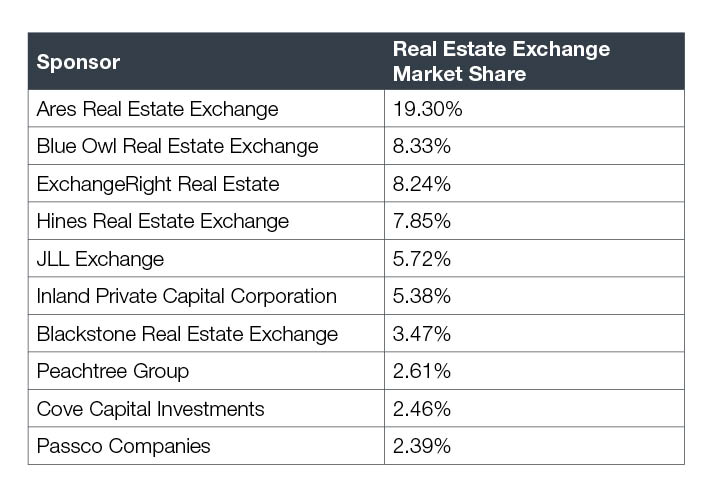
Among the 53 current active sponsors, 721 DSTs have represented more than half of total equity raised through September 30, 2026:5
- 12 sponsors offer only 721 DSTs
- 20 sponsors offer 721 DSTs and traditional 1031 DST solutions, allowing investors to choose
- Total equity raised is $7.5B, with approximately $3.9B or 52% dedicated to 721 DST-only transactions
- Total equity offered is $13.4B, with $7.1B or 53% dedicated to 721 DST-only transactions
Understanding Traditional 1031 DST and 721 DST Exchange Structures
A traditional 1031 exchange allows an investor to defer recognition of gain when selling real property held for investment or use in a trade or business and reinvesting in like-kind real property. Section 1031 of the Internal Revenue Code applies to exchanges of real property and requires investors to follow strict timing and identification timeframes, including identifying replacement property within 45 days and completing the exchange within 180 days. It is also critical to use a Qualified Intermediary to hold the exchange proceeds and ensure the investor does not take actual or constructive receipt of the funds during the exchange process.
A DST can be used as a replacement property in a 1031 exchange. Through ownership of DST interests, investors can own a fractional interest in professionally managed, institutional-quality real estate without taking on the responsibilities of day-to-day property management. DSTs can also offer access to various property sectors that may otherwise be difficult for individual investors to access directly. Additionally, through DSTs, investors have the option to invest in myriad types of real estate, creating their own customized diversified real estate portfolio.
A traditional 1031 DST typically has a hold period of seven to 10 years. This timing is due to one of the unique features of a DST. Under the DST structure, the asset manager generally is not able to refinance a DST’s debt, therefore, these offerings are usually created with a longer term loan. As the loan approaches maturity, the asset manager may seek to sell the investment and distribute the sale proceeds to investors in the form of cash. It is important to note that certain of these traditional DSTs may involve an UPREIT exit strategy, but, unlike a 721 DST, it allows investors to choose whether to receive cash or partnership units in the operating partnership of the REIT (OP units).
At the time of the sale, investors can choose one of the following scenarios:
- Keep the sale proceeds and use the proceeds for any purpose, while paying applicable capital gains tax
- Roll the sale proceeds into another DST, continuing the tax-deferral journey
- Exchange into directly owned real estate and resume active property management responsibilities
If the investor chooses to roll the sale proceeds into another DST, they can continue to defer their capital gains tax.
An investment into a 721 DST, by contrast, generally initially involves the steps above, with an investor first exchanging the proceeds from the sale of real estate into a beneficial interest in a DST. However, what distinguishes a traditional 1031 DST from a 721 DST is that in a 721 DST, the operating partnership of a REIT holds an option, but not the obligation, to acquire the properties owned by the DST. This option is typically exercisable two to three years after the DST capital raise. If the operating partnership exercises its option, the investors in the DST will not have the right to continue to retain their DST interests but instead will be required to exchange their DST interests for OP units. Investors’ transfer of their DST interests to the operating partnership in exchange for OP units is intended to qualify as a tax-deferred exchange under Section 721 of the Code. It is important to note that there is no assurance that as part of such a structure, the operating partnership will exercise its option and the DST investors will receive OP units.
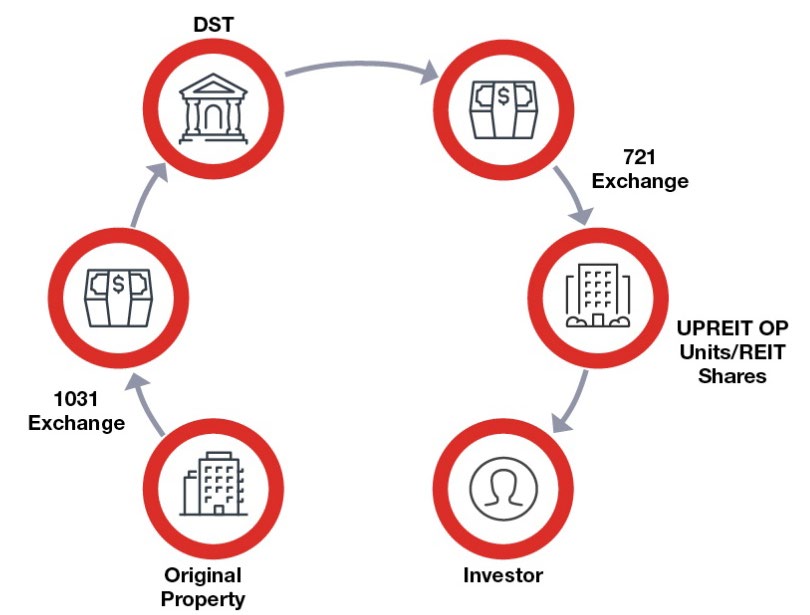
Arguably, the two commonly cited advantages of this approach are enhanced diversification and the potential for greater liquidity. REITs typically hold significantly more assets than a single DST due to their larger size. Additionally, in theory, if the REIT operating partnership exercises its option to acquire a DST’s property(ies) and the investors receive OP units, the investors will have the ability to request that the operating partnership of the REIT redeem the OP units for cash or potentially shares of REIT common stock. There are, however, three important considerations:
- Once an investor has received OP units, the investor is precluded from future 1031 exchanges. While investors may have the ability to liquidate their OP units – subject to redemption windows and the redemption options under the REIT’s governing documents – the investor would generally have to pay capital gains tax on the redemption of such units when this occurs.
- While investors may seek some future liquidity, the desire to avoid recognizing capital gains tax may lead them to want to continue to hold their OP units for a timeframe equal to or longer than a traditional 1031 DST hold period. This can work against the original stated intent of pursuing the exchange if liquidity was a primary objective.
- If the REIT manager decides to sell the asset that was contributed through the 721 exchange and is not able to structure the sale as an additional 1031 exchange, the investors may need to pay their capital gains tax, even though it was not their decision to sell.
When Should Investors Choose a 1031 DST or 721 DST?
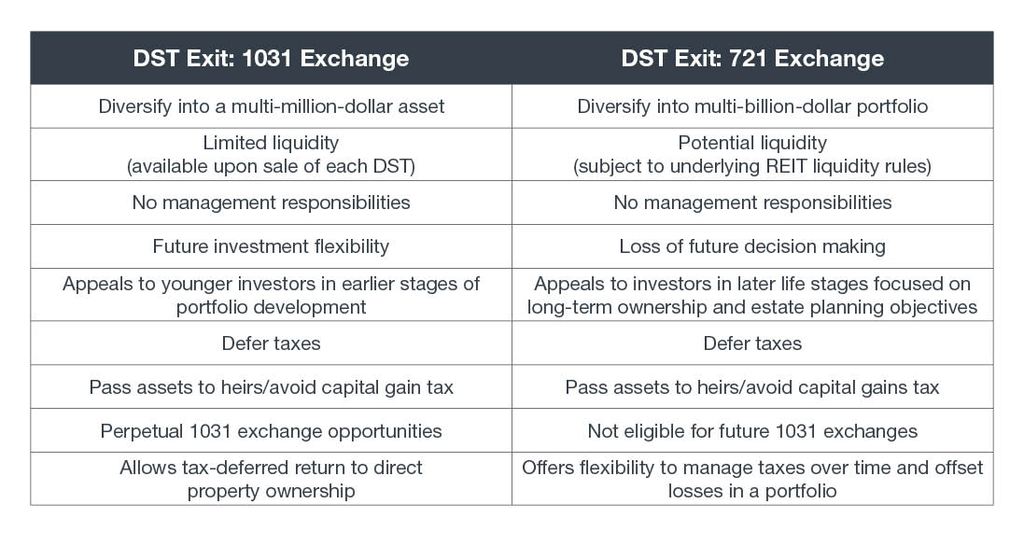
The chart below compares a traditional 1031 DST investment, in which the DST investors will have the ability to complete future 1031 exchanges at the time of exit, with a 721 DST investment, in which the investors will participate in a 721 exchange into the operating partnership of a REIT at the time of exit, if that operating partnership elects to exercise its option to acquire the DST’s assets.
Investors Need Access to Both Strategies
The decision between a traditional 1031 DST and a 721 DST should begin with the investor’s investment objectives and tax-planning needs, not with the product a sponsor has available. Although both structures may support tax-deferral, they can serve different needs and produce different long-term outcomes.
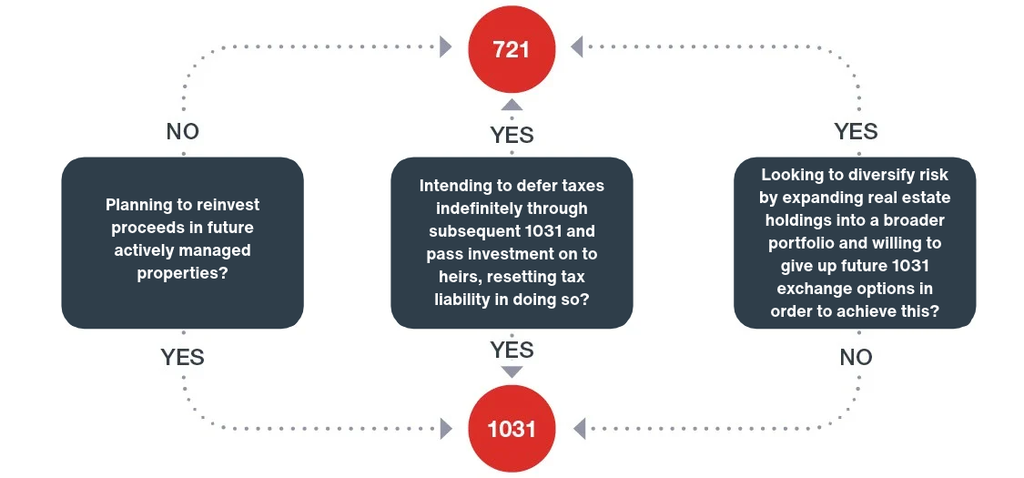
Traditional 1031 DST and 721 DST solutions are not interchangeable but may be complementary. Both serve as tax-deferral tools with each leading to different long-term outcomes.
- Traditional 1031 DSTs may preserve future 1031 exchange optionality, while 721 DSTs may shift the investor into a different ownership structure.
- Traditional 1031 DSTs may offer more visibility into a specific real estate asset or portfolio and its business plan, while 721 DSTs may provide exposure to a broader REIT platform with a different set of risks and decision-making considerations.
Because investor objectives vary, neither structure should be treated as the default answer. Financial professionals and investors are better positioned to make suitable choices when both strategies can be evaluated against specific tax objectives, liquidity needs, risk tolerance, estate planning priorities, investment timeline, and desire for future flexibility. It is also important to evaluate tax reporting requirements. A 721 exchange into the operating partnership of a REIT may involve more complex K-1 reporting than the traditional 1031 DST reporting that investors are accustomed to.
The Role and Appeal of 721 DST Solutions
DSTs providing for potential 721 exchange strategies can offer meaningful benefits for appropriate investors. They may provide access to a larger and more diversified real estate platform, reduce the need to identify replacement property within traditional 1031 timelines, and simplify ownership through a centralized structure.
In addition, some investors are attracted to 721 DSTs because they appear to offer potential access to liquidity when compared with a traditional real estate hold period of a traditional 1031 DST. However, investors should understand that even if they receive OP units or REIT shares as part of a 721 exchange, if their objective is to continue avoiding recognition of taxable gain, they may need to hold such OP units or REIT shares for a very long period of time, potentially until death or another tax-planning event. It is also important to note that liquidity is not guaranteed, and any redemption program offered by a REIT or its operating partnership is subject to the terms, limitations, and discretion of the entity. For investors focused on simplification, consolidation, and a more hands-off approach, these features can be compelling. However, the potential benefits should be evaluated alongside important trade-offs. The value of a 721 exchange depends on an investor’s specific objectives and should be a well-thought-out choice, not the default answer.
Key Considerations of 721 Strategies
Long-Term Flexibility: Once an investor acquires OP units following a 721 exchange transaction, the ability to execute future 1031 exchanges with that original investment amount is no longer available. For investors who value ongoing exchange optionality or a “swap till you drop” method, this can be a significant limitation. It may also affect estate planning strategies that rely on continued real estate ownership, future exchanges, and potential cost basis planning.
Liquidity: Although certain REITs and their operating partnerships may provide for limited liquidity for beneficial owners through redemption programs, such redemption programs should not be viewed as guaranteed liquidity and investors must be careful not to confuse a redemption feature with true liquidity. These programs are subject to significant restrictions, which may include limits on the amount that may be redeemed, timing constraints, board discretion, market conditions, and the ability of the REIT or its operating partnership to delay, limit, suspend or terminate redemptions. Investors should understand that a stated redemption program does not necessarily mean they will be able to access their capital when desired.
Transparency and Decision-Making: A traditional 1031 DST typically gives investors visibility into a specific property or portfolio and a defined business plan. With a 721 DST structure, if the operating partnership exercises its option and the DST investors receive OP units, decisions around leverage, acquisitions, dispositions, asset concentration, and market-cycle exposure typically are made by the REIT’s board of directors. While that may be appropriate for some investors, it also means reliance on the REIT’s overall strategy and governance structure.
Product Availability and Suitability: When a wealth management firm offers only one exchange solution, that structure may naturally lead the conversation. That does not mean the solution is inappropriate, but the investment recommendation should be thoroughly reviewed against the investor’s actual financial needs and goals. Product-driven recommendations can create misalignment when investors would have been better served by a traditional 1031 DST or by a broader evaluation of both structures.
The Enduring Value of Traditional 1031 DSTs
Traditional 1031 DSTs continue to play an important role in the exchange marketplace. For investors who want passive real estate ownership while staying within the 1031 structure, DSTs may offer an effective combination of tax-deferral, professional management, and access to institutional-quality real estate. They allow investors to remain invested in real estate without taking on the day-to-day responsibilities of direct property ownership.
One of the key benefits of a traditional 1031 DST is the potential for future 1031 exchanges. At the end of a DST’s hold period, investors have the choice to effectuate another 1031 exchange into new replacement property, following the same exchange timelines and guidelines. This flexibility can be particularly valuable for investors focused on long-term tax-deferral, estate planning or passing wealth to the next generation.
Traditional 1031 DSTs, as opposed to the REIT structure in which an investor may end up following a 721 exchange, may also provide more visibility into the underlying real estate. Investors can evaluate the property, real estate sector, location, tenant profile, financing options, business plan, projected hold-period, and even an exit strategy before investing in each subsequent DST. This asset-level transparency can help investors and financial professionals determine whether the opportunity aligns with income objectives, risk tolerance or any other criteria meaningful to the investor.
Beyond tax-deferral, these factors may appeal to investors seeking access to professionally managed real estate in sectors such as student housing, multifamily, healthcare, self-storage, retail and other property types, depending on market conditions and program availability. Access to such institutional real estate and engaging an experienced sponsor to manage the asset(s) allows investors to focus on priorities that matter most to them.
A Call for Balanced Industry Practices
We believe that the exchange industry should continue to evolve, but it should do so in a way that prioritizes education, transparency, and investor choice. Wealth management firms and their professionals, sponsors, investors, and investment platforms should be encouraged to evaluate both traditional 1031 DST and 721 DST solutions when appropriate, rather than defaulting to a single structure. We believe that investors should understand not only what a product offers, but also what the limitations may be.
Inland’s ability to offer both traditional 1031 DST and 721 DST solutions allows for balanced discussion with financial professionals and investors. The goal is not to advocate against 721 strategies, but to ensure that 721 DSTs are considered alongside traditional 1031 DSTs, with clear disclosure of pros and cons of each type of program. This approach supports better suitability analysis and a healthier exchange marketplace.
A balanced process should include discussions around:
- tax-deferral mechanics
- future exchange flexibility
- liquidity limitations
- estate planning implications
- product availability and sponsor economics
- asset-level transparency
- investor’s long-term objectives
As 721 strategies continue to gain attention, traditional 1031 DSTs should not be overlooked. They remain an important component of the tax-deferred real estate ecosystem and may be the more appropriate choice for many investors. A marketplace that offers both structures and explains both clearly is better equipped to serve investors responsibly.
Inland Supports Investor Choice
With decades of commercial real estate and exchange experience, Inland understands that tax-deferral is only one piece of the complex financial and estate planning process and, therefore, offers access to both traditional 1031 DST and 721 DST exchange strategies. Inland’s extensive suite of educational materials supports a balanced decision-making conversation and evaluation. A healthy exchange marketplace requires choice, transparency, and alignment with investor needs. Investors and financial professionals should be encouraged to evaluate both traditional 1031 DST and 721 DST strategies based on the investor’s objectives, not simply the sponsor’s product availability.
- “721 exchanges” refer to tax-deferred exchanges under Section 721 of the Internal Revenue Code of 1986, as amended (the “Code”).
- Mountain Dell Consulting data. September 30, 2026 Report.
- “1031” refers to Section 1031 of the Code. A Section 1031 tax-deferred exchange generally allows the seller of investment and business property to defer federal and state capital gains taxation on the sale by exchanging the relinquished property for another property of like kind.
- Mountain Dell Consulting. Year End Report 2025.
- Mountain Dell Consulting report 9-30-2026. Additional information not contained in the report is provided by Mountain Dell Consulting.
This report is neither an offer to sell nor a solicitation of an offer to buy any security which can be made only by a prospectus or offering memorandum that has been filed or registered with appropriate state and federal regulatory agencies, and sold by registered investment advisers authorized to do so.
Opinions expressed reflect the current opinions of Inland Real Estate Investment Corporation (Inland Investments) as of the date appearing in the materials only and are based on Inland Investment’s opinions of the current market environment, which is subject to change. The views expressed herein are subject to change based upon economic, real estate and other market conditions. These views should not be relied upon for investment advice. Any forward-looking statements are based on information currently available to us and are subject to a number of known and unknown risks, uncertainties and factors which may cause actual results, performance or achievements to be materially different from any future results, performance or achievements expressed or implied by these forward-looking statements. Past performance is not a guarantee of future results. Investors, financial professionals and prospective investors should not rely solely upon the information presented when making an investment decision and should review the most recent offering materials for the applicable investment program. Certain information contained in the materials discusses general market activity, industry or sector trends, or other broadbased economic, market or political conditions and should not be construed as research or investment advice. An investment in a 1031 DST and/or a 721 DST involves significant risk and is suitable only for investors who have adequate financial means, desire a relatively long-term investment and who will not need immediate liquidity for their investment and can afford to lose their entire investment. This communication is not intended as tax advice.
The Inland name and logo are registered trademarks being used under license. “Inland” refers to The Inland Real Estate Group of Companies, Inc. which is comprised of a group of independent legal entities some of which may be affiliates, share some common ownership or have been sponsored and managed by such entities or subsidiaries thereof. Inland Securities Corporation, member FINRA/SIPC, is dealer manager and placement agent for programs sponsored by Inland Investments and its affiliates. For more information on Inland Securities Corporation, visit FINRA BrokerCheck.